Well, spring is coming, no matter how far away it seems... this means we have the wonderful thing known as mud that's going to be covering every inch of our wonderfully furry friends. This is, in particular, most frustrating for us draft lovers. Mud stuck in feather is a PITA to deal with.
So, there's the issue of keeping your horses clean and happy as you put them (and yourselves!) back into training.
However, on top of this problem which is bad enough, say, in the middle of summer... us in the north also have to deal with horses shedding their winter coats.
So, this is a discussion! Share your mud and shedding solutions.
A few years ago I was introduced to a wonderful thing called a shedding stone. If your horses' winter hair is coming out in patches or if you have an early-mid spring show coming up and need your horse looking sharp, you can pick up a shedding stone at your local horse supply store. It also works for getting out stubborn patches of mud.
It's actually just a big pumice stone. It's smooth and gentle and feels like a massage.
If that's not available, I love the good old rubber curry comb. That, a body brush, and a damp cloth with thoroughly clean a coat just as well.
For feather, you can bring a bucket of warm water, plastic curry comb, mane comb, rag, and some elastic bands... soak the feather and wash it all out with the water and rag, brush it thoroughly and shampoo, whatever you need to do, comb it out and if you can manage it, blow dry it.
Separate the feather, band it, and braid it, fold it up like a plait and band it, and a workout later your draft won't have huge mud balls stuck to its feet.
You can keep it braided in the field, even. I'm not so sure about keeping it folded but again it saves the problems of your drafts coming in with mud balls stuck to their legs that makes you want to shear all that stuff off. I've only ever done it with show drafts... the others I just clip the feather right off in the spring, it's not worth it.
Of course nothing works better than a thorough bath. And dish soap.
Wednesday, March 11, 2009

Sunday, February 22, 2009
Meet Mike
Hello my name is Mike. Mel invited me to do blogs on her blog and as I've been thinking of keeping a horse blog myself I figured I might help her out. So a little about myself I guess.
I'm a ranch owner in Canada. I currently own five horses on my farm and I am boarding four more for clients. I've lived here for two years now. I've been riding since before I could walk and have competed in lower level cutting and roping and I currently compete up to a professional level in the show jumping community which is a good opportunity for travel and meeting different trainers so I really hope I can contribute to this blog.
Right now my horses include a arabian gelding, two clydesdale thoroughbred cross mares, a shire quarter horse cross mare, and a warmblood gelding. i hope to share more about them in the time to come. In the mean time feel free to ask me anything you want to know.
Tuesday, February 17, 2009
A quick blog entry on barrel racing
I love this sport. It's a bit of my thing, I'm OCD about everything about the sport from what horses should be doing it to how people should be riding the runs. It disappoints me how much bad horsemanship I see in the sport, everything from kicking the living hell out of the horses to clinging to the horn for dear life to yanking on the horse's mouth to jerking around uncontrollably on the saddle.
It all doesn't matter, as long as the run is fast. So I'm going to share with you my idea of a good barrel racing turn and a bad one, pulled off of a Google image search.
First, a bad one.

First off, what's with being able to fit the universe between your butt and the saddle? Second of all, the hands are straining at the reins and the horn because clearly a solid seat and legs aren't going to keep her on the horse, so we'll rely on its spine and poor, sensitive mouth (click here to see a full picture, complete with BIG LONG SHANKS on the bit...) and the hopes that the horse doesn't decide it doesn't like the hat the lady on the other side of the ring is wearing and takes off in the other direction (seriously, how would she stay on? Not a hope in hell).
There's the legs with the toes down and out, heels pressed into the sides for dear life (most likely the reason for flying out of the saddle) and the look on the horse's face says it all. Head up, neck stiff and tense, shallow stride, wide turn, ears back and a snarly look on the face that says "LADY LET GO OF MY MOUTH!" At least the horse is on the right lead.
Here is another horrible position to be in. We'll let you figure out what's wrong on your own... but I can tell you one thing, your legs don't belong THERE.
Here is an example of a good barrel turn.

I would like to see the heels come down, but the legs are quiet and gentle (the probable reason for the toes being down is that the stirrups don't seem to be in use at all, which is a good sign of balance), the balance of the rider is properly turned upward and staying in center. The hands are sitting quiet and forward without straining to the side on a huge curb, the horse is turning close, tight, and quick (note how far in he's leaning), and the rider is looking where she's going. She looks to be in balance and working hard for the horse. My other complaint besides the toes is how the horse's nose is for some reason turned out, likely a product of being checked for trying to turn too fast because the rest of the body is going into the turn nicely. But notice how relaxed this horse seems compared to the picture above. He's just doing his job. The other one looks like he'd shatter if you prodded him with a chisel.
It's just a nicer picture all-round. All it is is basic horsemanship...
When I was just four years old and in riding lessons, my trainer always told me that touching the horn would burn the horse. I knew, of course, she wasn't serious (it was the middle of winter!) but I used that to never cling to the horn and learned to rely on my balance. I never learned to ride with stirrups until I was eleven years old.
And speaking of four-year-old me... I have to hunt that picture down. Little me on a big horse in a class full of adults.
And how hard are you booting your poor animal that your heels are coming this far out from the horse's sides? Ouch.
It all doesn't matter, as long as the run is fast. So I'm going to share with you my idea of a good barrel racing turn and a bad one, pulled off of a Google image search.
First, a bad one.
First off, what's with being able to fit the universe between your butt and the saddle? Second of all, the hands are straining at the reins and the horn because clearly a solid seat and legs aren't going to keep her on the horse, so we'll rely on its spine and poor, sensitive mouth (click here to see a full picture, complete with BIG LONG SHANKS on the bit...) and the hopes that the horse doesn't decide it doesn't like the hat the lady on the other side of the ring is wearing and takes off in the other direction (seriously, how would she stay on? Not a hope in hell).

There's the legs with the toes down and out, heels pressed into the sides for dear life (most likely the reason for flying out of the saddle) and the look on the horse's face says it all. Head up, neck stiff and tense, shallow stride, wide turn, ears back and a snarly look on the face that says "LADY LET GO OF MY MOUTH!" At least the horse is on the right lead.
Here is another horrible position to be in. We'll let you figure out what's wrong on your own... but I can tell you one thing, your legs don't belong THERE.
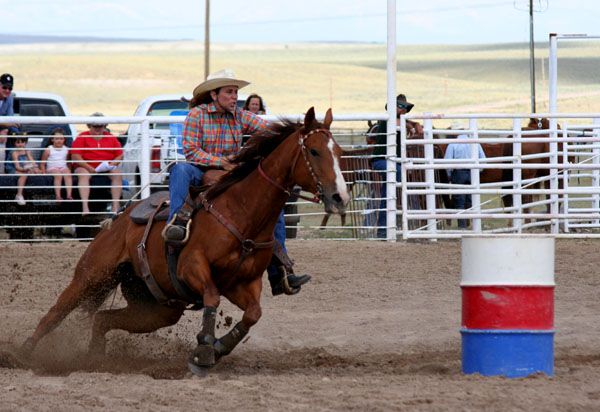
Here is an example of a good barrel turn.
I would like to see the heels come down, but the legs are quiet and gentle (the probable reason for the toes being down is that the stirrups don't seem to be in use at all, which is a good sign of balance), the balance of the rider is properly turned upward and staying in center. The hands are sitting quiet and forward without straining to the side on a huge curb, the horse is turning close, tight, and quick (note how far in he's leaning), and the rider is looking where she's going. She looks to be in balance and working hard for the horse. My other complaint besides the toes is how the horse's nose is for some reason turned out, likely a product of being checked for trying to turn too fast because the rest of the body is going into the turn nicely. But notice how relaxed this horse seems compared to the picture above. He's just doing his job. The other one looks like he'd shatter if you prodded him with a chisel.
It's just a nicer picture all-round. All it is is basic horsemanship...
When I was just four years old and in riding lessons, my trainer always told me that touching the horn would burn the horse. I knew, of course, she wasn't serious (it was the middle of winter!) but I used that to never cling to the horn and learned to rely on my balance. I never learned to ride with stirrups until I was eleven years old.
And speaking of four-year-old me... I have to hunt that picture down. Little me on a big horse in a class full of adults.
And how hard are you booting your poor animal that your heels are coming this far out from the horse's sides? Ouch.

Monday, February 16, 2009
Arena Footing
Q: I just put up a 70 foot round pen at our stable and I need to put in some good footing. Everybody says that beach sand is perfect. I live in Southern California and it is illegal to use beach sand. What would be a good, economical alternative in your opinion? Some say plaster sand, some say screened fill dirt base with shavings on top, others say to use dg base and some others say to use the muck you clean out from the stalls. Can you help?
A: Surprisingly enough, an option is rubber. I don't know if they're doing it down in the US, but in Canada people are using old tires to mix into asphalt, use as rubber mats in playground, and actually crumbling it up into a sand-like substance to use not only in playgrounds but horse arenas as well. It's got good grip, it's springy and absorbs shock, and there's not a lot of dust to go with it. The only problem is that it's expensive, but if you're willing to invest in something like that, here's a link:
http://www.equi-tread.com/
When you're looking for materials, you have to make sure it's not dusty, that it cushions that horse's steps but still has a good amount of traction. My recommendation would primarily be sand. It doesn't need to be beach sand, you can shop around and find out what's available. You can purchase it in fine or coarse grain, whatever you prefer, and have it shipped in. You would probably prefer a coarser grain, not so fine that it's going to create a lot dust. If you're using sand, you have to make sure that you aren't piling it very deep. Anything deeper than about five inches is going to be pretty stressful on the horse (you know what it feels like to run in loose sand, I'm sure). You can also mix sand with different footing materials to loosen them up.
The downside of sand is that it will pack down and erode and get crushed up after a while, so it will need replacing every once in a while and re-layering because the footing will become hard. Also, you'll need to mix and wet down the arena often as sand is very dry. Sand is also probably your cheapest option and will last anywhere from 5 to 11 years, depending on what you get.
A softer footing option is sawdust. Again, you can shop around and get more information on it, but sawdust does need to be replaced every couple years. Saw dust wouldn't necessarily mean the very fine dusty stuff you see after taking a power saw to a piece of wood, but rather looks like fine wood shavings and can be mixed with sand. The arena I currently ride in has wood product footing and the Thoroughbred gelding I'm working with just loves it, and we do show jumping. It's also great on the residing barrel horses' limbs.
And all of this stuff can be mixed. It's recommended that you mix rubber with sand for good footing and just run a harrow over it to keep it mixed up. If you're willing to invest, I would most likely recommend that option.
Sunday, February 15, 2009
When is the time to start riding a young horse?
I made this guide a few months back and figured it would be useful for any readers curious about what ground work should first be covered in a young horse.
This is an issue among many horse people, and I'm going to share some facts and honest opinions on how to tell if your horse is ready to be backed.
Most people figure that just jumping on and STAYING on is the first step to riding your horse. Nothing could be further from the truth. When you're breaking the horse to ride, you should have accomplished at least four things:
1) Your horse has been sacked out, and accustomed to a saddle and you draping yourself over it, rubbing your hands everywhere, and be used to the saddle sitting on it.
2) Your horse respects you in every way, showing good ground manners and a submission to you as the alpha being. A bond is also very important when backing; if the horse trusts you, you're in for a good ride.
3) The horse can steer. You can teach this 100% from the ground by teaching it to move off of pressure and by ground driving.
4) Letting the horse age to an appropriate stage.
First, let's discuss age.
IMO, a horse shouldn't be backed until it is 3.5-4yo. I'm also heavy-set, so I know that a younger horse could not support me properly. I let the horse develop and let its knees close and its spine form properly, letting it reach close to its maximum height before backing it.
The absolute youngest a horse should be backed is 3yo. Before 3, they are by far not developed enough to support the weight of a human; they're STILL babies at 1 and 2. Racehorse owners often back as a YEARLING and that just screws a horse up. Let's face it, if you get up too early, you're hurting it.
The results of backing a horse too young can be quite devastating. The following image is not Photoshopped in any way.

See? Gross. Now, let's compare. When you look at a full grown horse compared to a younger one, their neck has filled out slightly, their haunches have developed, they back has lengthened and muscled, and their legs have become more solid. Looking at the following yearling, you can see that he is still very slim, and his legs fragile. The joints are all still soft and mostly cartilage, and the back is flimsy.

Now, looking at a 2yo, you are seeing them grow into themselves, but they still have that little horse look. Their legs are strengthened, but as you can see, they are not, by far, fully developed. Their neck is mostly filled out, their haunches are developing nicely, and their back is still not up to holding the load. They're still going through many growth stages and leveling outs to do, so the best thing to do is stay out of their way.

At three years old, they still have some growing and filling out to do, but finally they are beginning to look like adult horses. They've leveled out about as much as they're going to, they've almost completely finished growing UPWARDS, and their legs are completely solid. Their backs are strong enough to take on light work... however, cantering/galloping/sharp turns with a rider is out of the question. It will still strain their joints. They still have some filling out to do, and their bones are not 100% developed.

This fact completely changes with drafts and bigger horses. You shouldn't back a draft at this stage, simply because he isn't developing as fast as a little horse. The following is a three year old Clydesdale. Note the differences:

This is a full-grown Clyde, for comparison
At four years old, you have a horse. 4yos are considered adult horses, but horses don't stop growing and filling out until they are 6 or 7. At this point, you don't want to put the horse through anything rigorous such as barrel racing or jumping: that should be left to the 5-and-6-year-olds. You STILL have to be careful of the horse's joints. Remember, they're STILL very young.

And at last, you have a 6yo horse. Yes, I skipped 5, that's because 5 is boring. They are mature and filled out and ready to start their show life!

Moving on from the matter of age...
After you're sure your horse is physically able to carry you, you have to worry about their mental state. Not only do you not want to annoy, frighten, or confuse them, but you want to ensure that this ride is perfectly safe for you.
You want the horse to have the utmost respect for you at this point. After teaching them all the groundwork and rules, personal space and respect problems, you will have a well-behaved horse that isn't going to bolt away or trample you or kick AT you when you try to mount it for the first time.

You also want a horse you have bonded with. Does HE trust YOU? Will he let you touch him all over and rub things on him? A big part of trust-building is sacking out your horse, getting him used to plastic bags, tarps, ropes, etc, etc. A good horse will just walk over or under a tarp no problem. A good horse will let you fling a tarp right over him with no fuss.


A horse that trusts you will follow you, let you approach it, let you touch it, etc. It will trust your comforting. This does NOT fall outside of the spooking line. A horse is a horse and every horse will spook no matter who it is with. That is something completely different.


Also, you want a horse that has been worked under saddle. Under saddle =/= under rider. You'll want to have introduced the saddle to the horse, let it wear it for a bit... you'll want the horse to be used to a saddle. Even if you're going to get up bareback for the first time (which I've done but recommend against). That also means that you've lunged the horse with the saddle, lead it around, let it graze with it... it means you've pulled on the stirrups a bit, adjusted all the straps periodically, and it means you can saddle the horse without him fussing.


The SAME THING goes for a bridle. Lunging and everything.

The horse, before you mount, should have been taught to move off of pressure. Pressure on the neck, on the sides on the face, etc. Basic groundwork. This way, it will respond to the pressure of your heel, the pressure of reins or hands on its neck, and the pressure of your seat.

The horse should know that a clicking sound means move forward. Push-button, in other words.

Also, to teach it how to steer before you get on, ground driving is an EXCELLENT thing to teach a young horse before backing. Remember, if you get on that horse and he doesn't have steering or breaks... you're just begging for an accident to happen to you or your horse. Crap happens, no matter how hard you work to avoid it.

A horse who is ready for you to back him will also let you drape yourself right over him without caring. He'll be comfortable with it and trust you to be okay with him.

Some people also work with lying their horses down during work (especially if the horse is very disrespectful and a handful). I personally have only ever done this with a couple of horses, but it's up to you.


Well, I think I've gotten everything! If your horse is okay with all of these things, hop right on up and happy trails to you and your baby.
This is an issue among many horse people, and I'm going to share some facts and honest opinions on how to tell if your horse is ready to be backed.
Most people figure that just jumping on and STAYING on is the first step to riding your horse. Nothing could be further from the truth. When you're breaking the horse to ride, you should have accomplished at least four things:
1) Your horse has been sacked out, and accustomed to a saddle and you draping yourself over it, rubbing your hands everywhere, and be used to the saddle sitting on it.
2) Your horse respects you in every way, showing good ground manners and a submission to you as the alpha being. A bond is also very important when backing; if the horse trusts you, you're in for a good ride.
3) The horse can steer. You can teach this 100% from the ground by teaching it to move off of pressure and by ground driving.
4) Letting the horse age to an appropriate stage.
First, let's discuss age.
IMO, a horse shouldn't be backed until it is 3.5-4yo. I'm also heavy-set, so I know that a younger horse could not support me properly. I let the horse develop and let its knees close and its spine form properly, letting it reach close to its maximum height before backing it.
The absolute youngest a horse should be backed is 3yo. Before 3, they are by far not developed enough to support the weight of a human; they're STILL babies at 1 and 2. Racehorse owners often back as a YEARLING and that just screws a horse up. Let's face it, if you get up too early, you're hurting it.
The results of backing a horse too young can be quite devastating. The following image is not Photoshopped in any way.
See? Gross. Now, let's compare. When you look at a full grown horse compared to a younger one, their neck has filled out slightly, their haunches have developed, they back has lengthened and muscled, and their legs have become more solid. Looking at the following yearling, you can see that he is still very slim, and his legs fragile. The joints are all still soft and mostly cartilage, and the back is flimsy.
Now, looking at a 2yo, you are seeing them grow into themselves, but they still have that little horse look. Their legs are strengthened, but as you can see, they are not, by far, fully developed. Their neck is mostly filled out, their haunches are developing nicely, and their back is still not up to holding the load. They're still going through many growth stages and leveling outs to do, so the best thing to do is stay out of their way.
At three years old, they still have some growing and filling out to do, but finally they are beginning to look like adult horses. They've leveled out about as much as they're going to, they've almost completely finished growing UPWARDS, and their legs are completely solid. Their backs are strong enough to take on light work... however, cantering/galloping/sharp turns with a rider is out of the question. It will still strain their joints. They still have some filling out to do, and their bones are not 100% developed.
This fact completely changes with drafts and bigger horses. You shouldn't back a draft at this stage, simply because he isn't developing as fast as a little horse. The following is a three year old Clydesdale. Note the differences:
This is a full-grown Clyde, for comparison

At four years old, you have a horse. 4yos are considered adult horses, but horses don't stop growing and filling out until they are 6 or 7. At this point, you don't want to put the horse through anything rigorous such as barrel racing or jumping: that should be left to the 5-and-6-year-olds. You STILL have to be careful of the horse's joints. Remember, they're STILL very young.
And at last, you have a 6yo horse. Yes, I skipped 5, that's because 5 is boring. They are mature and filled out and ready to start their show life!
Moving on from the matter of age...
After you're sure your horse is physically able to carry you, you have to worry about their mental state. Not only do you not want to annoy, frighten, or confuse them, but you want to ensure that this ride is perfectly safe for you.
You want the horse to have the utmost respect for you at this point. After teaching them all the groundwork and rules, personal space and respect problems, you will have a well-behaved horse that isn't going to bolt away or trample you or kick AT you when you try to mount it for the first time.
You also want a horse you have bonded with. Does HE trust YOU? Will he let you touch him all over and rub things on him? A big part of trust-building is sacking out your horse, getting him used to plastic bags, tarps, ropes, etc, etc. A good horse will just walk over or under a tarp no problem. A good horse will let you fling a tarp right over him with no fuss.
A horse that trusts you will follow you, let you approach it, let you touch it, etc. It will trust your comforting. This does NOT fall outside of the spooking line. A horse is a horse and every horse will spook no matter who it is with. That is something completely different.
Also, you want a horse that has been worked under saddle. Under saddle =/= under rider. You'll want to have introduced the saddle to the horse, let it wear it for a bit... you'll want the horse to be used to a saddle. Even if you're going to get up bareback for the first time (which I've done but recommend against). That also means that you've lunged the horse with the saddle, lead it around, let it graze with it... it means you've pulled on the stirrups a bit, adjusted all the straps periodically, and it means you can saddle the horse without him fussing.
The SAME THING goes for a bridle. Lunging and everything.
The horse, before you mount, should have been taught to move off of pressure. Pressure on the neck, on the sides on the face, etc. Basic groundwork. This way, it will respond to the pressure of your heel, the pressure of reins or hands on its neck, and the pressure of your seat.
The horse should know that a clicking sound means move forward. Push-button, in other words.
Also, to teach it how to steer before you get on, ground driving is an EXCELLENT thing to teach a young horse before backing. Remember, if you get on that horse and he doesn't have steering or breaks... you're just begging for an accident to happen to you or your horse. Crap happens, no matter how hard you work to avoid it.
A horse who is ready for you to back him will also let you drape yourself right over him without caring. He'll be comfortable with it and trust you to be okay with him.
Some people also work with lying their horses down during work (especially if the horse is very disrespectful and a handful). I personally have only ever done this with a couple of horses, but it's up to you.
Well, I think I've gotten everything! If your horse is okay with all of these things, hop right on up and happy trails to you and your baby.
Updates on the blog
Okay, so... seems we have more people starting to read (and even comment!) in the past couple of days so I'm going to make a change.
I know a few of you had questions for me, whether you're my former co-workers or people I met on my internet rantings through FHotD or HTG or HLU or wherever else you might have come from, and this blog is the spawn of people prodding me to make one about horses instead of just my general rant blog.
So, we're going to change it. It's not just about your questions any more, it's about whatever's going to pop into my mind. Every week I'll do my best to post a question from a reader or otherwise, but the rest of it is just going to be good old horse information as it pops into my brain!
Happy readings, happy trails!
Saturday, February 14, 2009
Backyard breeding
Anonymous, from my e-mail.
Q: why do you think that its so bad for someone like me to breed their horse in their own home if they are going to use it for their own purposes? its not like were flooding the world with horses like huge organizations like the aqha.
A: I think you have the wrong idea.
I, in no way, think that it is bad for people to breed a single horse and keep it for their own purposes... under the right circumstances.
First of all, I have no problem if people breed good, quality horses. This means good conformation, a good disposition, they've done something else in their life other than reproduction (they can be handled, ridden, and preferably shown), and the two horses breeding have to be a good match if a crossbreed is being made.
Good general conformation: are they built nice and solidly, with strong limbs that won't break down under the pressure of work? Halter QHs are notoriously bad for having tiny hooves, horridly upright pasterns, and post legs in the back... this is not a good thing. These are the horses that break down early in life and are tossed to the auction pen, limping away around the ring. You want a good, sloping shoulder, a strong, deep haunch, and a solid back (no roach backs or sway backs!). Solid legs, as I've already said... that means fair-sized hooves, solid pasterns, good knees and a strong upper arm. In the hind leg, you want clean hocks and a solid gaskin, and a good bend in the hind leg to allow for free motion. Aside from the conformation that allows the horse to work to the best of its abilities, you want an attractive horse.
Why? Because you CANNOT 100% guarantee that something will not happen where you have to sell your horse, and a horse that is built well and looks good has a BIG CHANCE of finding a good home. Attractiveness means he's well put-together and doesn't look like a franken-horse. It also means a good, long neck and a cute head that doesn't look like someone hit a brick with a hammer a couple of times.
This is an example of a badly-conformed Warmblood:

And a well-conformed one:

A badly-conformed QH:

And a well-conformed one:

Ask yourself which ones you'd rather buy.
As for good matches... something like a Percheron and a QH go well together. QH and TB go well together, Arab and TB, Belgian and QH, Percheron and Clyde go brilliantly together, Clyde and TB is also a very awesome mix. Arabs and Saddlebreds... I could go on forever on matches that look good and make sense.
Things like Freisian and QH... Percheron and Akhal-Teke... those things, not so great actually. They won't come out so well.
Aside from looking good and acting well, the farm has to have a proper foaling facility if the mare is giving birth on site... and then good foal fencing for when the foal is there. This means NOT pagewire and NOT barbed wire. Good, strong fencing that the horses cannot hurt themselves on, especially dorky foals who will end up doing some stupid things.
A solid income is a must. If you don't have a regular job, then don't breed. If you're having a hard time supporting one horse, don't make another! The fees don't gradually increase... they DOUBLE when you double your amount of horses. Double the feed, double the vet care, double the tack...
Also, you must have the skills or resources to ensure that this foal gets trained. If you, yourself, do not know how to train a horse, RESEARCH IT PROPERLY. Figure out what a foal should be able to do and how to teach them safely and properly. If you can't do it, send them to a WELL-KNOWN, WELL-RESPECTED, NEARBY trainer and then CHECK UP ON THEM UNANNOUNCED. You think that's paranoid? Go read my last blog.
And last but not least (actually, the most important and first thing you should do), you need to ask yourself if you can pick up an identical foal at the auction kill pen and save its life. You can go on forever about how SPESHUL your horse is (there are other special horses out there), how you want to witness the miracle of birth (have your own kid?), or how you don't want to have to spend the money buying a foal (for your information, buying a foal is waaay cheaper than putting the mare through pregnancy... with the vet checks, ultrasounds, extra food, etc), I've heard every excuse. I think. I hope.
But the fact of the matter is, if you breed something and the resulting baby is identical to a foal that went to slaughter, then you just added to the horse slaughter and overpopulation problem.
And don't make assumptions. Go and ATTEND an auction. Visit the kill pen after... there are lots of NICE HORSES that fall through the cracks, many of them just babies. Some even come with papers.
Do you want to create a new life and send that one to its death, or do you want to give that one a chance at life and take a baby step forward, for the horses? I will guarantee you, saving a slaughter-bound horse will be the BEST feeling of your life. And they're cheap! Very cheap.
Some are as cheap as $40. Some can be more expensive.
I'm always faced with the argument, "I'm not adding to the overpopulation problem... it's just one horse!" Or, "how is my TINY breeding facility adding to the problem."
Here's the thing. It's like littering. You toss one gum wrapper on the ground thinking "oh, just one won't kill the environment," while someone across the street from you tosses a napkin away thinking the exact same thing... and thousands of other people around the city thinking the same. "Oh, one won't hurt."
Soon your city is piled up with trash and it's disgusting to look at, and things like city clean-ups need to take place.
It's the same here. Hundreds of thousands of farms are thinking "oh, this little bit won't add to the problem" and suddenly there are hundreds of thousands of foals born, most of which they think they can make money off of, and sell at an auction... the vast majority of the foals end up being sent to slaughter, either as babies or later on in life when they suddenly aren't wanted any more.
And again, you can argue until you're blue in the face that the foal is for you.
But you can never know for sure that you will be able to keep it for your whole life. Shit happens. You want to guarantee that in the event that you need to sell your horse, it has a chance at the future.
And YES, I know that huge AQHA farms pump out thousands of babies a year and they are the problem too. Their problem is much, much harder to fix because those mass farms are in it for the money, and the money only. They couldn't care less about the over-population problem, as long as they get paid at the end of the day. But that's a debate for another day.
Q: why do you think that its so bad for someone like me to breed their horse in their own home if they are going to use it for their own purposes? its not like were flooding the world with horses like huge organizations like the aqha.
A: I think you have the wrong idea.
I, in no way, think that it is bad for people to breed a single horse and keep it for their own purposes... under the right circumstances.
First of all, I have no problem if people breed good, quality horses. This means good conformation, a good disposition, they've done something else in their life other than reproduction (they can be handled, ridden, and preferably shown), and the two horses breeding have to be a good match if a crossbreed is being made.
Good general conformation: are they built nice and solidly, with strong limbs that won't break down under the pressure of work? Halter QHs are notoriously bad for having tiny hooves, horridly upright pasterns, and post legs in the back... this is not a good thing. These are the horses that break down early in life and are tossed to the auction pen, limping away around the ring. You want a good, sloping shoulder, a strong, deep haunch, and a solid back (no roach backs or sway backs!). Solid legs, as I've already said... that means fair-sized hooves, solid pasterns, good knees and a strong upper arm. In the hind leg, you want clean hocks and a solid gaskin, and a good bend in the hind leg to allow for free motion. Aside from the conformation that allows the horse to work to the best of its abilities, you want an attractive horse.
Why? Because you CANNOT 100% guarantee that something will not happen where you have to sell your horse, and a horse that is built well and looks good has a BIG CHANCE of finding a good home. Attractiveness means he's well put-together and doesn't look like a franken-horse. It also means a good, long neck and a cute head that doesn't look like someone hit a brick with a hammer a couple of times.
This is an example of a badly-conformed Warmblood:
And a well-conformed one:
A badly-conformed QH:
And a well-conformed one:
Ask yourself which ones you'd rather buy.
As for good matches... something like a Percheron and a QH go well together. QH and TB go well together, Arab and TB, Belgian and QH, Percheron and Clyde go brilliantly together, Clyde and TB is also a very awesome mix. Arabs and Saddlebreds... I could go on forever on matches that look good and make sense.
Things like Freisian and QH... Percheron and Akhal-Teke... those things, not so great actually. They won't come out so well.
Aside from looking good and acting well, the farm has to have a proper foaling facility if the mare is giving birth on site... and then good foal fencing for when the foal is there. This means NOT pagewire and NOT barbed wire. Good, strong fencing that the horses cannot hurt themselves on, especially dorky foals who will end up doing some stupid things.
A solid income is a must. If you don't have a regular job, then don't breed. If you're having a hard time supporting one horse, don't make another! The fees don't gradually increase... they DOUBLE when you double your amount of horses. Double the feed, double the vet care, double the tack...
Also, you must have the skills or resources to ensure that this foal gets trained. If you, yourself, do not know how to train a horse, RESEARCH IT PROPERLY. Figure out what a foal should be able to do and how to teach them safely and properly. If you can't do it, send them to a WELL-KNOWN, WELL-RESPECTED, NEARBY trainer and then CHECK UP ON THEM UNANNOUNCED. You think that's paranoid? Go read my last blog.
And last but not least (actually, the most important and first thing you should do), you need to ask yourself if you can pick up an identical foal at the auction kill pen and save its life. You can go on forever about how SPESHUL your horse is (there are other special horses out there), how you want to witness the miracle of birth (have your own kid?), or how you don't want to have to spend the money buying a foal (for your information, buying a foal is waaay cheaper than putting the mare through pregnancy... with the vet checks, ultrasounds, extra food, etc), I've heard every excuse. I think. I hope.
But the fact of the matter is, if you breed something and the resulting baby is identical to a foal that went to slaughter, then you just added to the horse slaughter and overpopulation problem.
And don't make assumptions. Go and ATTEND an auction. Visit the kill pen after... there are lots of NICE HORSES that fall through the cracks, many of them just babies. Some even come with papers.
Do you want to create a new life and send that one to its death, or do you want to give that one a chance at life and take a baby step forward, for the horses? I will guarantee you, saving a slaughter-bound horse will be the BEST feeling of your life. And they're cheap! Very cheap.
Some are as cheap as $40. Some can be more expensive.
I'm always faced with the argument, "I'm not adding to the overpopulation problem... it's just one horse!" Or, "how is my TINY breeding facility adding to the problem."
Here's the thing. It's like littering. You toss one gum wrapper on the ground thinking "oh, just one won't kill the environment," while someone across the street from you tosses a napkin away thinking the exact same thing... and thousands of other people around the city thinking the same. "Oh, one won't hurt."
Soon your city is piled up with trash and it's disgusting to look at, and things like city clean-ups need to take place.
It's the same here. Hundreds of thousands of farms are thinking "oh, this little bit won't add to the problem" and suddenly there are hundreds of thousands of foals born, most of which they think they can make money off of, and sell at an auction... the vast majority of the foals end up being sent to slaughter, either as babies or later on in life when they suddenly aren't wanted any more.
And again, you can argue until you're blue in the face that the foal is for you.
But you can never know for sure that you will be able to keep it for your whole life. Shit happens. You want to guarantee that in the event that you need to sell your horse, it has a chance at the future.
And YES, I know that huge AQHA farms pump out thousands of babies a year and they are the problem too. Their problem is much, much harder to fix because those mass farms are in it for the money, and the money only. They couldn't care less about the over-population problem, as long as they get paid at the end of the day. But that's a debate for another day.
Subscribe to:
Posts (Atom)